

A local professional buyer almost always pays more for a used phone or gadget than an ecoATM kiosk, because a person can inspect and grade your device instead of guessing. We recommend a trusted local buyer like We Buy Electronics Miami for most sellers. An ecoATM still makes sense when you want instant cash on the spot and don’t mind trading dollars for convenience.
TL;DR:
- EcoATM kiosks offer instant cash and require no appointment, but their offers are based on worst-case device valuations and tend to be lower.
- Local buyers perform hands-on inspections, check IMEI status, test components, and provide offers that typically exceed kiosk payouts, especially for higher-end devices.
- Selling multiple devices or newer models to a trusted local buyer generally yields a higher total return and more accurate grading than a kiosk.
- Preparing your device with a factory reset, removing accounts, and documenting condition improves offers from both options, with local buyers offering better recourse if issues arise.
- The fastest option is ecoATM for old or damaged devices, but for maximum value and security, a local professional buyer is usually the better choice.
Table of Contents
- EcoATM vs Local Buyer: Comparing Value, Speed, and Safety
- How EcoATM Kiosks Work and What to Expect
- Why Local Professional Buyers Usually Pay More
- How to Choose Between a Kiosk and a Local Buyer
- Prepping Your Device Before You Sell
- Why a Trusted Local Buyer Is Usually the Better Bet
- The Bottom Line: Choose a Local Buyer First
- How Long Does Each Selling Method Actually Take?
- What Fees or Hidden Costs Should You Watch For?
- What Happens After the Sale Is Complete?
- Get a Fair Cash Offer Without the Kiosk Guesswork
- Sources
EcoATM vs Local Buyer: Comparing Value, Speed, and Safety
The gap between these two options comes down to one thing: information. A kiosk can’t verify your phone’s IMEI status, check for financing locks, or test whether the battery actually holds a charge. It has to assume the worst. A local buyer can look, test, and ask questions, so they can offer real value instead of a defensive lowball.
That’s why local buyer write-ups consistently find that ecoATM pays less than in-person buyers for the same device. Consumer finance coverage backs this up too: ecoATM is the fastest and easiest option, but generally the one that pays the least.
Here’s how the two stack up on what actually matters when you’re deciding where to sell:
- Typical payout: Local buyers usually beat kiosk offers, sometimes by a wide margin on newer or higher-end devices.
- Speed and convenience: ecoATM wins here. You walk up, scan, and walk away with cash in minutes with no appointment needed.
- Device grading accuracy: Local buyers test cameras, buttons, batteries, and screens directly. Kiosks rely on automated checks and your own answers.
- Payment timing: Both pay instantly on the spot, but a local buyer’s cash offer reflects your device’s real condition, not a worst-case guess.
- Safety and verification: Reputable local buyers require ID and issue receipts. Kiosks handle this automatically but offer no human recourse if something goes wrong.
- Prep required: Both need a factory reset and account removal first.
The quick decision rule: if you want the most cash and can spare fifteen extra minutes, go local. If you need instant cash right now and the device is old, low value, or you’re in a hurry, an ecoATM will get the job done.
How EcoATM Kiosks Work and What to Expect
An ecoATM kiosk walks you through a short, automated process. You select your device type and model on the touchscreen, place the phone in the scanning tray, and the machine inspects the screen and body for visible damage using its camera and sensors. It checks basic functions, asks you to answer a few condition questions, and generates an instant cash offer. Accept it, and the kiosk pays out on the spot, usually in cash or through a linked payment option.
The catch is in how that offer gets calculated. Kiosks use worst-case valuation by design. Since a machine can’t physically test whether your camera focuses correctly or confirm your phone isn’t reported lost or financed, it prices in that uncertainty by assuming the worst outcome. ecoATM’s own FAQ acknowledges this, noting that the kiosk is built for instant, secure convenience rather than maximum payout, and points sellers toward other channels for potentially higher returns.
Devices that tend to lose the most value at a kiosk:
- Phones with cracked screens or visible body damage, even if they still work fine
- Older or discontinued models with limited resale demand
- Devices missing original accessories or with non-original replacement parts
- Phones the kiosk flags for manual review, which can reduce or void the offer entirely
Pro Tip: If your phone still powers on and passes activation lock checks, test every button and port before you go. A kiosk that detects an unresponsive volume button or a flaky charging port will price that risk into your offer, even if the issue is minor.
ecoATM makes the most sense for an old phone gathering dust, a cracked device you just want gone, or a situation where you need cash immediately and don’t want to deal with meeting anyone in person.
Why Local Professional Buyers Usually Pay More
A local buyer’s advantage starts with something a kiosk simply can’t do: look you and your device in the eye. Human inspection catches details automated grading misses entirely, and that difference shows up directly in the offer.
What a thorough local inspection actually covers:
- IMEI lookup to confirm the phone isn’t reported lost, stolen, or under active financing
- Storage capacity verification, since mislabeled storage is a common source of kiosk underpricing
- Battery health and charging cycle checks
- Camera, speaker, and port testing under real use conditions
- Confirmation that internal parts are original, not aftermarket replacements that reduce resale value
Market knowledge plays a bigger role than most sellers expect. A buyer who tracks daily resale demand knows a specific model is running short in local inventory and can offer more without guessing. Buyers who can also salvage working components from non-functional devices, like screens, cameras, or logic boards, have more room to make a competitive offer even on damaged units. That salvage potential is exactly what kiosks are built to avoid pricing in, since they can’t evaluate component-level value on the spot.
Logistics matter too. Most local buyers offer both walk-in and appointment-based visits, so you can show up when it’s convenient or schedule ahead if you’re selling multiple devices. Expect a quick ID check, a receipt for your records, and cash before you leave.
Trust signals worth checking before you go: a real, verifiable business address, a written receipt policy, and a visible track record of customer reviews. A buyer with all three has far less incentive to lowball you or disappear after the sale.
How to Choose Between a Kiosk and a Local Buyer
Your decision should rest on four criteria: how much value you need, how fast you need it, how much privacy matters to you, and how much convenience you’re willing to trade for a better price.
- Rank your priority. If maximum cash matters most, local buyers win almost every time. If speed matters most and the device is low value anyway, a kiosk works fine.
- Ask the right questions before committing. Does the buyer check IMEI status? What conditions do they accept (cracked screens, dead batteries, water damage)? Do they pay immediately in cash, and do they provide a written receipt?
- Watch for red flags. A buyer who refuses to give a receipt, insists on meeting somewhere other than a business location, or pressures you to accept an offer on the spot is not someone to trust with your device or your data.
- Match your situation to the option. Selling a newer phone or a batch of devices for top dollar points toward a local buyer. Needing cash in the next ten minutes for an old phone points toward a kiosk.
A phone that still passes an IMEI check, holds a charge, and has an intact screen is worth asking a human buyer to look at before you settle for an automated worst-case number.
For most sellers weighing where to sell electronics for cash, the decision matrix is simple: value and safety concerns point to a local buyer, while pure urgency and low expectations point to a kiosk.
Prepping Your Device Before You Sell
A little prep work protects your data and helps whoever’s buying give you an accurate offer instead of a cautious one.
- Back up everything first. Photos, contacts, and app data should move to a cloud account or another device before you touch anything else.
- Sign out of every account. Remove your Apple ID or Google account and disable Find My iPhone or Find My Device, since an active lock will tank or void your offer.
- Factory reset the device. This wipes personal data completely and is the single most important step for your own security.
- Pull the SIM card and any SD card. These aren’t part of the sale and often get forgotten in the rush.
- Photograph the device’s condition. A few clear shots of the screen, back, and any damage help support an accurate offer, especially if you’re comparing quotes.
Pro Tip: Bring your original charger, box, or accessories to an in-person sale if you still have them. Complete sets routinely earn a better offer than a bare phone, even when the phone itself is in identical condition.
For an in-person sale, bring a valid photo ID, the device fully charged, and any purchase receipt if you have one.
Why a Trusted Local Buyer Is Usually the Better Bet
Most sellers get the best outcome from an experienced, in-person buyer, and the reasons come down to how the transaction actually works. We Buy Electronics Miami inspects every device by hand before making an offer, which means you’re paid for what your phone, laptop, or tablet actually is, not what a machine assumes it might be.
That in-person model cuts risk for the seller as well. A physical business location, immediate cash on the spot, and a written receipt give you recourse a kiosk transaction simply doesn’t offer. Publisher materials outlining the buying process show the same emphasis: no shipping, no waiting for a check, no mystery about who’s on the other end of the deal.
Where this model fits best:
- Selling a newer or higher-end phone where accurate grading meaningfully changes the payout
- Selling multiple devices at once, where a human buyer can evaluate everything in one visit
- Any situation where safety and a verifiable transaction matter more than shaving off ten minutes
| What matters to you | Kiosk (ecoATM) | Local buyer |
|---|---|---|
| Highest possible payout | Rarely | Usually |
| Fastest possible transaction | Yes | Close second |
| Accurate condition grading | Limited | Strong |
| Human recourse if something’s wrong | None | Receipt and business address |
We Buy Electronics Miami also buys well beyond phones, including laptops, tablets, gaming consoles, and cameras, which matters if you’re clearing out more than one device at a time.
The Bottom Line: Choose a Local Buyer First
For most sellers, a trusted local buyer beats an ecoATM kiosk on payout, accuracy, and peace of mind. Three moves put that into action right now: wipe and back up your device, get a quick estimate from a local buyer before you commit to anything, and choose between that offer and a kiosk based on how much speed versus value actually matters to you today. If your phone is old, heavily damaged, or you genuinely need cash in the next few minutes with zero flexibility, an ecoATM kiosk remains a reasonable fallback.
How Long Does Each Selling Method Actually Take?
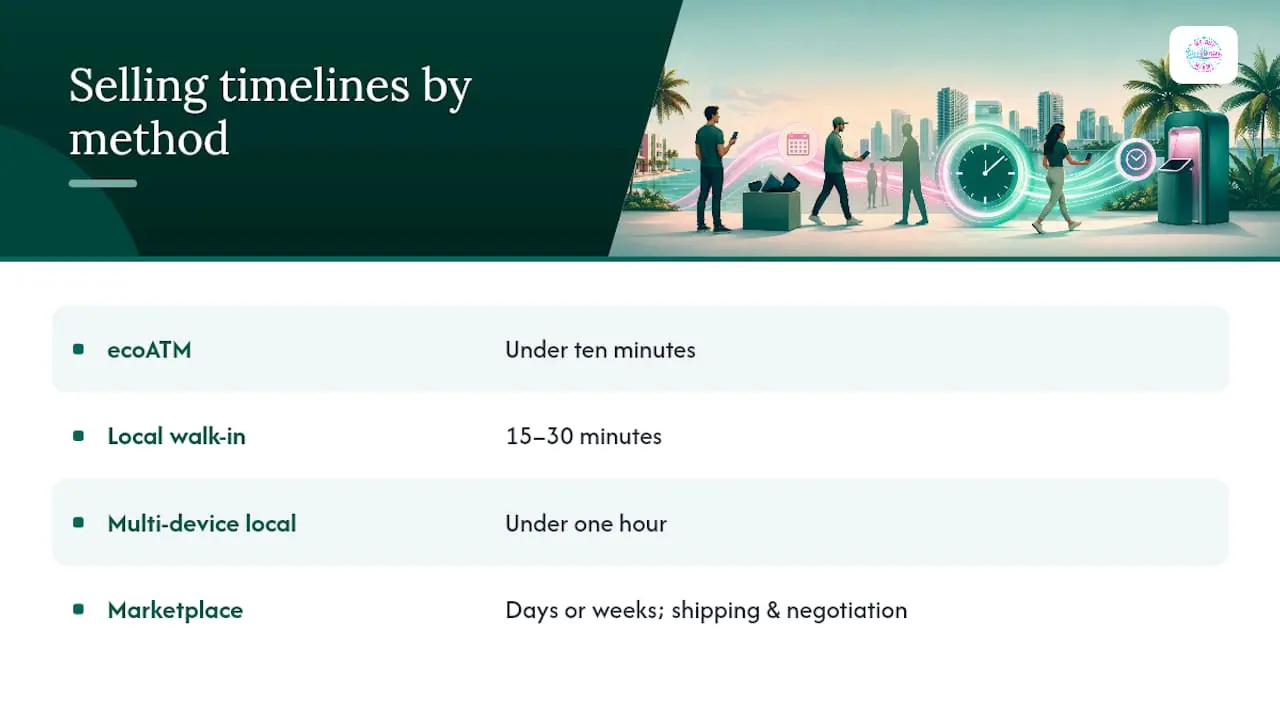
An ecoATM transaction is about as fast as selling gets. From the moment you scan your device to walking away with cash, most sellers are done in under ten minutes, since the entire process is automated and requires no appointment or conversation.
A local, in-person sale takes a bit longer but rarely turns into a long ordeal. Walk-in visits typically run fifteen to thirty minutes total, covering the inspection, the offer, a quick ID check, and payment. If you schedule an appointment ahead of time, the in-person portion often moves faster since the buyer already knows what you’re bringing in.
Where local buyers can add time is when you’re selling several devices at once, since each item needs its own inspection. Even then, most sellers wrap up a multi-device sale in under an hour, which is still far faster than listing items individually on a marketplace and waiting for buyers to respond, negotiate, and arrange pickup or shipping.
Compare that to selling on a platform like eBay, where a listing might sit for days or weeks before it sells, and you still have to handle packaging, shipping, and buyer questions afterward. If speed matters at all, both ecoATM and local buyers beat marketplace selling by a wide margin. The real choice is between a few extra minutes for a better price locally, or near-instant cash at a kiosk.
What Fees or Hidden Costs Should You Watch For?
Selling in person, whether at a kiosk or to a local buyer, avoids most of the costs that eat into marketplace sales. There’s no listing fee, no shipping label to buy, and no percentage cut taken by a platform. That said, the two in-person options aren’t identical when it comes to what you actually walk away with.
ecoATM builds its costs into the offer itself rather than charging a separate fee. The lower payout you see reflects the kiosk’s worst-case pricing model, not a line-item deduction, but the effect on your wallet is the same either way: less cash in hand.
A reputable local buyer generally doesn’t charge sellers anything either. The offer you’re quoted is the cash you receive, with no deductions for inspection, testing, or paperwork. Where sellers occasionally run into unexpected costs is with less established buyers who advertise a high price online, then reduce the offer once they’ve inspected the device in person, citing issues that weren’t disclosed upfront.
The safest move is asking directly whether the quoted price is final before you hand over your device, and getting that confirmation in person rather than relying on an online estimate alone. A buyer who won’t commit to a number after inspecting your device is one to walk away from.
What Happens After the Sale Is Complete?
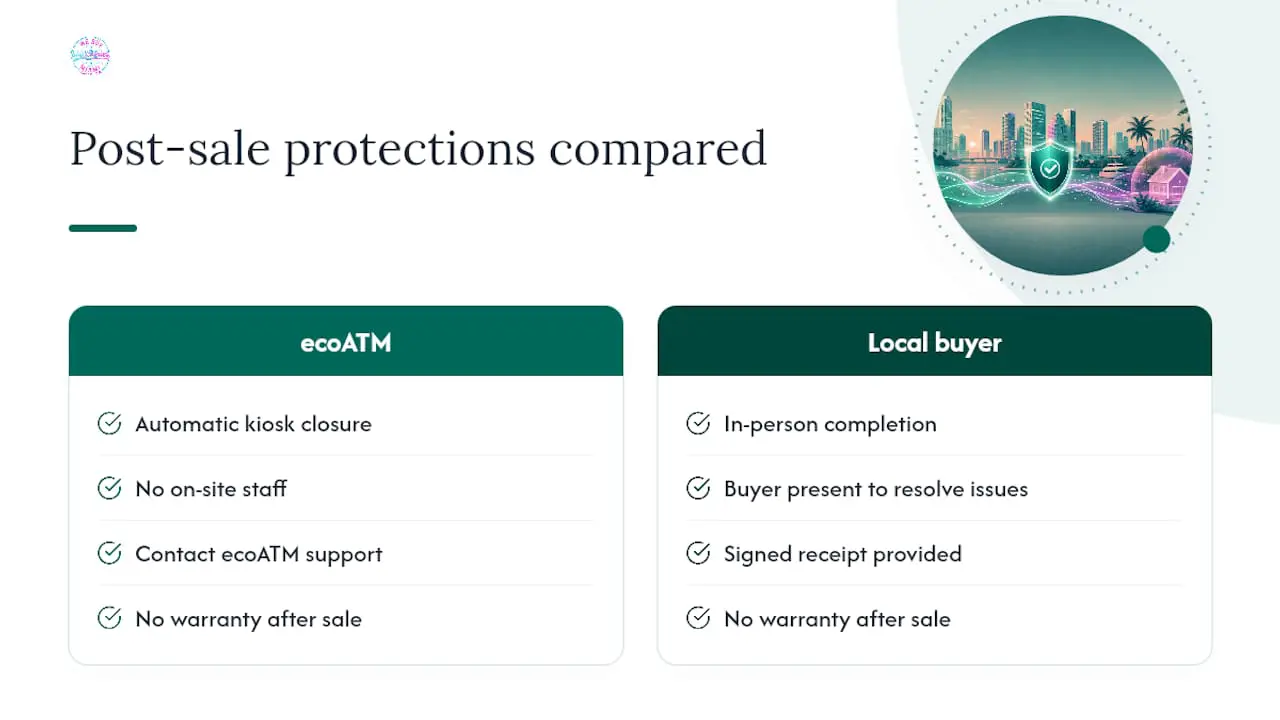
Once cash changes hands, the transaction is typically final for both ecoATM and local buyers, so most of the protection you get comes from what happens before that point, not after.
ecoATM transactions close automatically once you accept the kiosk’s offer and take the payout. If a dispute comes up later, such as a payment issue or a disagreement over the condition assessment, your only recourse is contacting ecoATM’s customer service directly, since there’s no person on-site to resolve it in the moment.
A local, in-person sale gives you a clearer paper trail. A reputable buyer provides a signed receipt at the time of sale that documents the device, the price, and the date, which matters if any question comes up afterward. That receipt is also your record for tax purposes or in the rare case a dispute needs to be resolved.
Neither option typically comes with a warranty, since you’re selling the device, not buying one. Once the sale is complete, the device belongs to the buyer and any issue that surfaces later, mechanical or otherwise, is no longer your responsibility. The one thing worth double-checking before you leave either transaction: confirm the payment method and amount match what you agreed to, and don’t leave without your receipt if a local buyer offers one.
Get a Fair Cash Offer Without the Kiosk Guesswork
If you’ve read this far, you already know the tradeoff: kiosks pay for speed, local buyers pay for accuracy. We Buy Electronics Miami is the alternative to rolling the dice at a kiosk. Every device gets a hands-on inspection, so your offer reflects what your phone, laptop, or tablet is actually worth instead of an automated worst-case guess.
There’s no shipping box to find, no waiting days for a check to clear, and no online listing to babysit. You bring the device in, we inspect it on the spot, and you walk out with cash the same visit. That applies whether you’re selling one iPhone or clearing out a drawer full of old gadgets at once.
Check what your device is worth before you settle for a kiosk’s number. Browse what we buy to see the full range of accepted devices, or head straight to our phone-selling page to get a same-day cash offer.
Sources
- ecoATM: Fastest and easiest, but generally less money – GoBankingRates
- Frequently Asked Questions – ecoATM
