

A typical used Nintendo 3DS sells for amounts generally considered in the low to mid-hundreds of dollars, with ranges varying by model and condition. Higher-tier models like the New 3DS XL command significantly more than original or base units, reflecting factors such as screen type and cosmetic condition. Original 2DS units tend to sell for lower prices compared to other models. If you need cash today, a local buyer offering an on-the-spot payment is your fastest route. If you want top dollar, a private sale or auction listing to a collector may yield higher returns than quick offers, but it generally takes longer and carries more risk.
TL;DR:
- Prices for higher-tier models like the New 3DS XL and dual-IPS units are now frequently between $200 and $350, driven by scarcity and collector interest.
- Condition factors such as hinge integrity, battery health, and screen type significantly impact the final resale value, often more than cosmetic appearance.
- Special editions and factory-sealed units can fetch 50% to 80% higher prices, especially if they feature dual-IPS screens or are in mint condition.
- Selling options vary from local buyers offering instant cash to online marketplaces and auctions that may yield higher prices but take longer and involve risks.
- Current market demand and scarcity suggest that holding sealed or limited-edition units could be more profitable, but damaged or functional-used consoles sell best locally for quick cash.
Table of Contents
- Nintendo 3DS Resale Value by Model: Current Price Ranges
- What Condition Factors Actually Change the Price?
- Where Should You Sell Your Nintendo 3DS?
- How Do You Price and List a 3DS for the Best Offer?
- Is Now a Good Time to Sell, or Should You Hold?
- Get an Instant Cash Offer for Your Nintendo 3DS Today
- Where to Verify Prices Before You Sell
- Sources
Nintendo 3DS Resale Value by Model: Current Price Ranges
The 3DS resale market has shifted dramatically over the past year, and the numbers below reflect that. PriceCharting’s console index tracks average sale prices across marketplaces, and when you cross that against recent retail reporting, a clear pattern emerges: newer, larger, IPS-capable models are pulling far higher prices than the original 2011 hardware.
TechSpot reported that many used New 3DS and 3DS XL listings in late 2025 were commonly landing in the $200 to $350 range, a figure that would have sounded absurd just two years earlier for handhelds that originally retailed well below that. That is not a fluke listing here or there. It is a market-wide repricing driven by scarcity and renewed collector attention.
Here is how the models typically break down right now:
| Model | Typical used range | Mint/limited/boxed premium |
|---|---|---|
| Original Nintendo 3DS | typically lower price range | premium possible for sealed or limited-edition boxes |
| Nintendo 3DS XL | generally moderate price range | premium possible for dual-IPS units in excellent condition |
| Nintendo 2DS / 2DS XL | typically the most affordable range | modest premiums on some variants |
| New Nintendo 3DS | generally higher price range | premium possible for special-edition faceplates |
| New Nintendo 3DS XL | highest price range among models | notable premiums for dual-IPS and sealed-in-box units |
RetroTechLab’s 2026 price guide breaks these ranges down further by region variant and faceplate rarity, and it notes something sellers often miss: special editions and factory-sealed units can command premiums of 50% to 80% over a standard used unit in the same model line. That is not a small bump. A sealed New 3DS XL that might sell for an average price can fetch a substantially higher amount from collectors due to its scarcity and condition.
The dual-IPS screen detail deserves its own callout, since it is the single biggest price separator within any given model. Early New 3DS and New 3DS XL production runs shipped with a mix of IPS and older TN-style panels, and buyers cannot tell which they are getting just by looking at a listing photo. Units confirmed to have dual-IPS displays, meaning both the top and bottom screens use the sharper, wider-viewing-angle technology, consistently sell above the midpoint of their model’s range. A standard New 3DS XL might land at $220. Confirm dual-IPS and document it in your listing, and that same unit can push past $300.
None of this means every unit you own automatically hits the top of its range. Condition, accessories, and functional status still swing the final number by a wide margin, which is exactly what the next section covers.
What Condition Factors Actually Change the Price?
Buyers care about function far more than they care about scuffs. A 3DS with surface wear but solid functional components generally sells better than a cosmetically pristine unit with major functional issues like battery or screen failures. RetroTechLab’s guide makes this point directly: collectors prioritize functional longevity and screen type over surface-level cosmetics, and that priority shows up in what people are actually willing to pay.
Here is what buyers and trade-in evaluators check, in roughly the order they check it:
- Hinge integrity. Loose, cracked, or wobbly hinges are one of the most common age-related failures and one of the fastest ways to tank an offer.
- Battery health. A swollen battery is a safety issue, not just a cosmetic one, and most buyers will either deduct heavily or walk away.
- Screen condition and type. Delamination, dead pixels, and touchscreen calibration issues all get tested, and confirming whether you have IPS panels can significantly raise your number.
- Included accessories. A charger, stylus, and original box all add real value, especially for collectors who want a complete package.
- Working cartridge slot and buttons. A console that will not read game cards or has sticky buttons gets priced like a parts unit, not a working console.
- Homebrew or modding status. Pre-modded units appeal to some buyers and may command higher prices in that niche, though they may be less desirable to collectors seeking original, unmodified units.
Pro Tip: Test your battery before you list anything. Remove the back panel, check for any bulging or warping around the battery casing, and if you see it, mention that condition upfront. Buyers who find a hidden battery problem after purchase leave bad reviews and demand refunds, which costs you far more than an honest disclosure ever would.
The homebrew question deserves a closer look because it cuts both ways. Comicbook of the 2025 to 2026 price run-up points to homebrew and modding interest as a real demand driver, particularly since the Nintendo eShop closure left many owners looking for alternate ways to access their digital libraries. A unit already set up for homebrew can command a premium from buyers who want that functionality without doing the work themselves. But if you are selling to a collector who wants an untouched, factory-original console for display or resale documentation, a modded unit is the wrong fit and may sell for less to that buyer.
Where Should You Sell Your Nintendo 3DS?
Your best channel depends on what you are optimizing for: speed, maximum price, or minimum hassle. No single option wins on all three.
- Private sale (Facebook Marketplace, Reddit hardware swap communities, OfferUp): Highest potential price since you cut out any middleman, but it takes the longest and exposes you to no-show buyers, lowball haggling, and in-person meeting risks. If you go this route, meet in a public location, bring a friend, and accept cash only.
- Auction and marketplace listings (eBay): Good for rare or sealed units where competitive bidding can push the price above a fixed listing. Expect seller fees around 10% to 13% of the sale price plus shipping costs and packaging time, and factor those into your minimum acceptable offer.
- National mail-in trade-in programs: Convenient if you are not in a rush, but payouts typically run well below what a private sale or local buyer would offer, and you are shipping a device you cannot inspect or negotiate on once it is in the mail.
- Pawn shops: Fast cash, but offers are usually the lowest of any channel since the shop needs margin to resell.
- Local cash buyers: A strong middle ground for sellers who want speed and certainty without shipping a device to a stranger. This is the right call when your unit is damaged, you need money today, or you simply do not want to deal with buyer scams, chargebacks, or waiting on a check.
- Specialty collector channels (retro gaming forums, Discord trading communities): Best for sealed, limited-edition, or dual-IPS units where the right buyer will pay well above general marketplace value.
If your 3DS has a cracked screen, a dead hinge, or a battery that will not hold a charge, most private buyers will simply pass. That is where a local cash buyer earns its keep, since they can evaluate a broken unit in person and make an offer without asking you to ship a nonfunctional device somewhere and hope for the best.
How Do You Price and List a 3DS for the Best Offer?
Getting a fair number starts with research, not guesswork. Here is a straightforward process:
- Check sold listings, not asking prices. Filter eBay and similar marketplaces to show completed sales only, then cross-reference against PriceCharting’s console values to see the recent average for your exact model.
- Photograph everything, including flaws. Show the hinge from the side, the screen at an angle to reveal scratches, and the battery compartment. Buyers trust listings that disclose problems more than ones that hide them.
- Disclose modding status clearly. State plainly whether the unit is stock or has any custom firmware installed, since this single detail determines which buyers will even consider your listing.
- Set a starting price near the midpoint of your model’s typical range, then adjust up if you can confirm dual-IPS screens or a complete box, or down if there are functional issues.
- Decide your negotiation floor before you list. For private sales, expect offers 10% to 15% below your asking price and know your walk-away number in advance.
That variance is exactly why two nearly identical consoles can sell for very different amounts.
If you get an instant cash offer that meets your floor, taking it now usually beats holding out for a marginally better private-sale number weeks later, especially once you account for shipping risk, buyer flakiness, and your own time.
Is Now a Good Time to Sell, or Should You Hold?
Prices are elevated for reasons that are unlikely to reverse soon. Nintendo’s eShop closure pushed collectors and homebrew enthusiasts toward physical hardware, IPS-screen scarcity keeps driving bidding on the best-condition units, and general retro-gaming nostalgia has widened the buyer pool well beyond hardcore collectors, as ComicBook.com’s market analysis lays out.
Use this checklist to decide your move:
- Urgency: Need cash this week? Sell now through a local buyer rather than waiting on an auction cycle.
- Model rarity: A common original 2DS is not likely to appreciate much further. A sealed or dual-IPS New 3DS XL might.
- Condition: A unit with a failing battery or hinge will only get harder to sell as parts age further. Sell it now rather than risk further decline.
- Target price: If a current offer already meets your number, taking it removes all future risk.
- Risk appetite: Holding sealed, limited-edition stock for future appreciation is a reasonable bet for collectors. Holding a daily-use console you are not playing anymore usually is not.
Sealed and limited editions genuinely function as collectibles rather than gaming devices at this point, and treating them that way, patience included, tends to pay off. A working console you are not using is a different story. It only loses value sitting in a drawer.
Get an Instant Cash Offer for Your Nintendo 3DS Today
If you have read this far and just want a fair number in hand without the marketplace back-and-forth, a local buyer offering instant cash payments can provide a faster, more certain path than listing online and waiting on a stranger. One alternative to shipping your console to an unknown buyer or waiting weeks on a mail-in trade-in check is to bring your device to a local buyer who can inspect it in person and pay cash on the spot.
This works best if you need money now, your 3DS has cosmetic or functional damage that scares off private buyers, or you simply do not want to deal with packaging, shipping labels, or the risk of a buyer disputing the sale after the fact. We evaluate your device in person on the spot, so there is no waiting for a shipping quote to bounce back and no guessing whether an online buyer will actually pay what they promised.
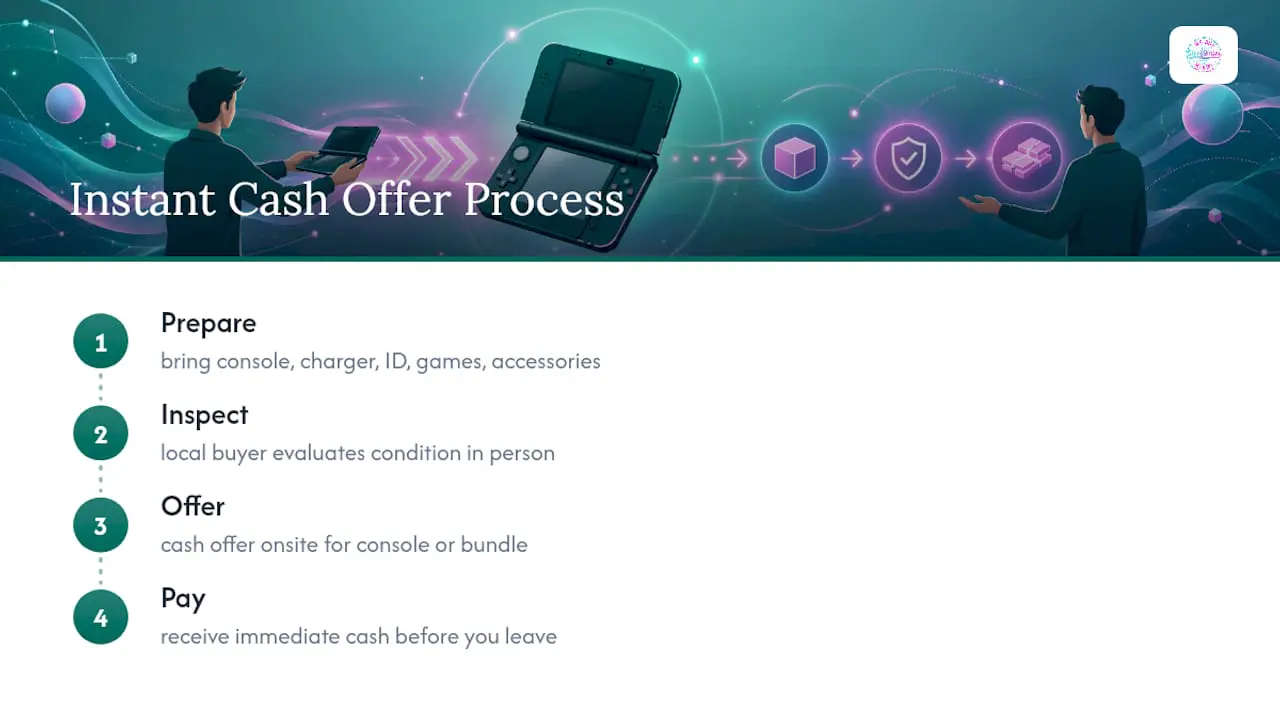
Before you come in, gather your console, its charger if you have it, a valid ID, and any game cartridges or accessories you want to include in the sale, since complete bundles typically fetch more than a bare console alone. We evaluate handhelds the same way we evaluate the wide range of electronics we buy, from laptops to gaming consoles, with the same straightforward process: inspect, offer, pay. Visit We Buy Electronics Miami to check today’s offer for your Nintendo 3DS and get paid before you leave.
Where to Verify Prices Before You Sell
Cross-check any offer against PriceCharting’s live console values for model-specific averages, and read RetroTechLab’s condition-based price guide for a deeper breakdown by variant. For context on why prices climbed, ComicBook.com’s market feature covers the eShop closure and collector demand driving the trend, and the same collector-demand dynamics show up in adjacent hobby markets like the one MagicFranco documents for Pokémon cards.
Sources
- Nintendo 3DS Prices & 3DS Value Guide
- Nintendo 3DS Price Guide 2026: Market Values, Condition Factors, and Collector Decision-Making – RetroTechLab
- Comicbook
- Used Nintendo 3DS consoles are commanding nearly Switch 2 prices amid retro gaming boom | TechSpot
