

Trade in your Apple device when speed and certainty matter more than the last dollar. Sell it privately when the payout gap is worth your time. The rough dividing line is about $80: below that gap, convenience usually wins; above it, selling privately almost always pays off. We’ll walk you through both paths below, including how to prep your device, price it fairly, and protect yourself either way.
TL;DR:
- Private sales generally yield about $80 or more above trade-in offers, especially for recent, unlocked Pro models in good condition.
- Preparing your device properly by backing up, removing iCloud, and photographing its condition can protect you from value reductions or disputes.
- Timing your sale before the September launch boosts resale value, as demand remains high and market supply is lower.
- Selling locally for cash offers same-day payment and avoids shipping risks, especially for damaged or older devices.
- Trade-in offers depend on inspection, with potential value reductions if your device’s condition differs from the report, impacting final payout.
Table of Contents
- Apple Trade In vs Selling: A Quick Comparison
- How Does Apple Trade In Actually Work?
- Why Does Private Selling Usually Pay More?
- What’s the Break-Even Rule for Trade In vs Selling?
- How Do You Prepare Your Device Before Selling or Trading It In?
- When Is the Best Time to Sell an Apple Device?
- What Safety Rules Should You Follow When Selling or Trading In?
- Why a Local Cash Buyer Is the Faster Cash Option
- Sources
Apple Trade In vs Selling: A Quick Comparison
Before you commit to either route, it helps to see the trade-offs side by side. Here’s how Apple Trade In, private sale, and a local in-person cash buyer stack up against each other:
- Apple Trade In: Payout is typically lower than the open market, paid as instant credit toward a purchase, and the process takes minutes but depends on passing inspection.
- Private sale (marketplaces or peer-to-peer): Payout is usually the highest of the three, paid as cash after the sale closes, but it takes days to weeks and requires listing, negotiating, and shipping.
- Local in-person cash buyer: Payout sits between the other two, paid as cash on the spot, and the transaction is done in minutes with no shipping or waiting for a buyer to respond.
If you’re a busy upgrader trading in at checkout, Apple’s credit is the path of least resistance. If you own a Pro model or a recent unlocked phone in clean condition, selling privately usually captures the biggest premium. If your device is damaged, older, or you just need cash today, a local buyer often beats both.
How Does Apple Trade In Actually Work?
Getting an Apple trade-in quote starts online at apple.com/trade-in or in person at an Apple Store. You answer a few questions about the model, storage, and condition, and Apple gives you a preliminary number. That number is not final.
Apple trade-in quotes are conditional on inspection and can be revised downward once your device arrives. If you’re mailing it in, Apple sends a prepaid box; you have roughly 14 days to ship it before the offer expires. Once it lands, a technician checks the screen, back glass, battery health, and whether Find My iPhone and Activation Lock have been removed. Any mismatch between what you reported and what they find, and the payout drops.
Payout comes in one of two forms:
- Trade-in credit applied directly toward a new Apple purchase at checkout.
- A gift card if you’re not buying anything new right now.
Apple almost never beats the open market on price. Trade-in quotes are conditional and typically trail private-sale pricing, according to applenewsnet.com’s comparison. What you’re really paying for is convenience.
Trade-in makes the most sense in three situations: you’re upgrading at checkout and want the credit applied instantly, your device has damage that would scare off a private buyer, or you simply don’t want to deal with photographing, listing, and shipping to a stranger.
Why Does Private Selling Usually Pay More?
Peer-to-peer marketplaces consistently return more cash than trade-in programs, according to Swappa’s analysis, because trade-ins are priced to cover the convenience and resale risk the buyer absorbs. Selling privately shifts that margin back to you, at the cost of your time.
Here’s the basic process:
- Check current sold prices for your exact model, storage size, and carrier status on a marketplace before you list, not the asking prices of other sellers.
- Take honest, well-lit photos of the front, back, sides, and any wear, since buyers pay a premium for devices that match the pictures exactly.
- Disclose unlocked status and battery health up front. An unlocked device with battery health above 85% sells faster and for more than a carrier-locked one with a tired battery.
- Choose your channel: shipping opens you to a wider buyer pool and typically higher offers, while a local meetup skips shipping fees and lets the buyer inspect in person before paying.
- Factor in fees before you accept an offer. Marketplace fees and shipping materials can eat into your margin, so price with that in mind rather than backing it out after the sale.
Recent, unlocked, high-storage Pro models see the largest gaps between trade-in and resale value. Wired’s guide to selling an old iPhone notes that peer-to-peer platforms tend to maximize cash precisely because they cut out the reseller’s markup.
Pro Tip: List during a short, defined window, one week is plenty, and refresh the listing every day or two. Stale listings signal desperation and invite lowball offers.
What’s the Break-Even Rule for Trade In vs Selling?
Before you decide, run through these factors: your device’s model and age, its cosmetic and battery condition, whether you’re buying a new Apple product anyway, how much time you actually have, and how strong local demand is for your specific model.
- Model and age (newer and Pro models hold value longest)
- Cosmetic condition and battery health
- Whether you’re purchasing something new from Apple
- Time available to list, negotiate, and ship or meet a buyer
- Local demand for your specific model and storage size
The practical rule of thumb: if the gap between Apple’s quote and a realistic private-sale price is under roughly $80, take the trade-in credit and move on, according to break-even analysis from TheSavvyGamer. Above that, the extra effort of selling privately pays for itself.
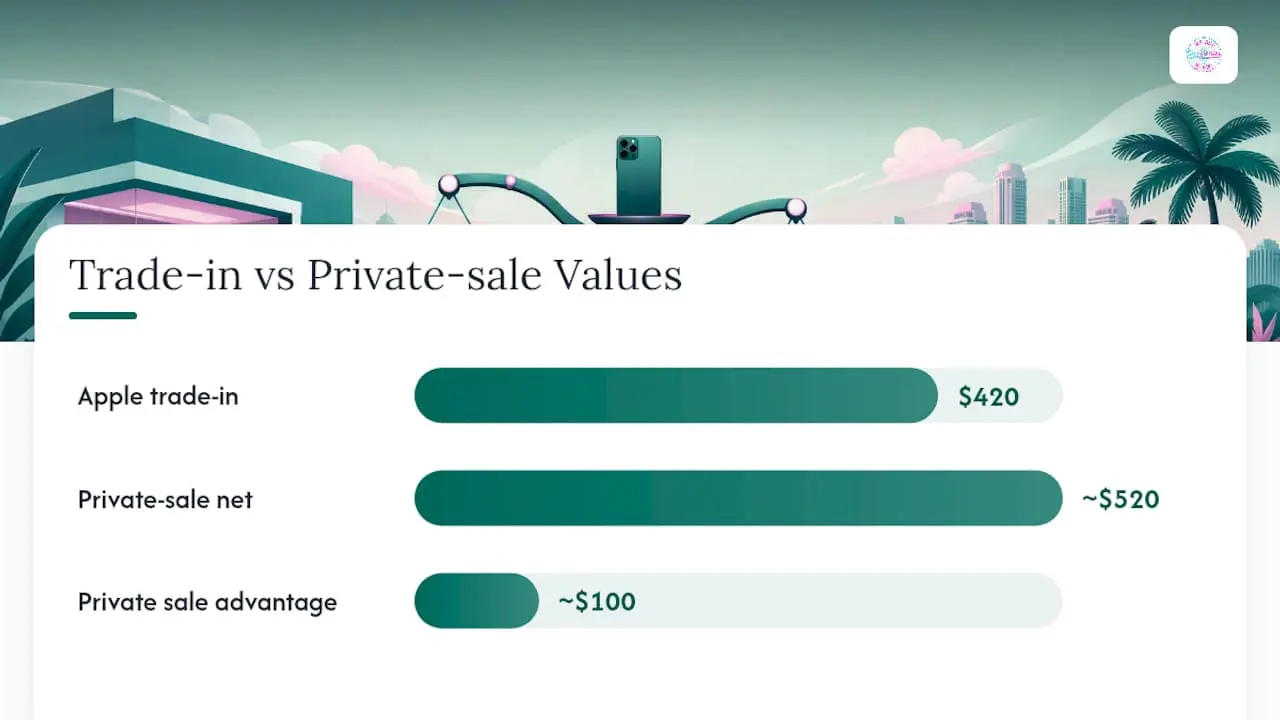
Worked example: Apple quotes you $420 credit for a clean iPhone 15, 128GB. A quick check of sold listings shows similar units going for $560. Subtract $30 to $40 in fees and shipping, and you’re still netting around $520, a gap of roughly $100 over the trade-in offer. That clears the break-even line, so selling privately wins.
One exception: Apple occasionally runs promotional trade-in bonuses tied to new launches, which can temporarily close or even flip that gap. Always pull Apple’s quote first. It’s a useful floor even if you end up selling elsewhere.
How Do You Prepare Your Device Before Selling or Trading It In?
Whichever route you pick, the prep work is nearly identical, and skipping it is the fastest way to lose money or get flagged during inspection.
- Back up your data through iCloud or your computer so nothing is lost.
- Sign out of iCloud and remove the device from Find My. Devices still linked to Find My or Activation Lock get rejected or devalued on the spot, whether it’s Apple’s inspector or a private buyer.
- Factory reset the device through Settings so it boots to the setup screen for the next owner.
- Write down the IMEI or serial number and keep it somewhere safe in case a dispute comes up later.
- Take dated, timestamped photos of the device’s condition before you ship or hand it over. This is your proof if a trade-in quote gets revised downward.
- Note battery health honestly (found under Settings > Battery) since both Apple and private buyers factor it into the price.
Small cosmetic fixes, like removing a case or wiping fingerprints, are worth the five minutes they take. Disclose real issues, cracked glass, swollen battery, prior repairs, rather than hoping nobody notices. If your carrier plan uses an eSIM, transferring your eSIM profile to a new device before you hand off the old one avoids activation headaches for whoever buys it next.
When Is the Best Time to Sell an Apple Device?
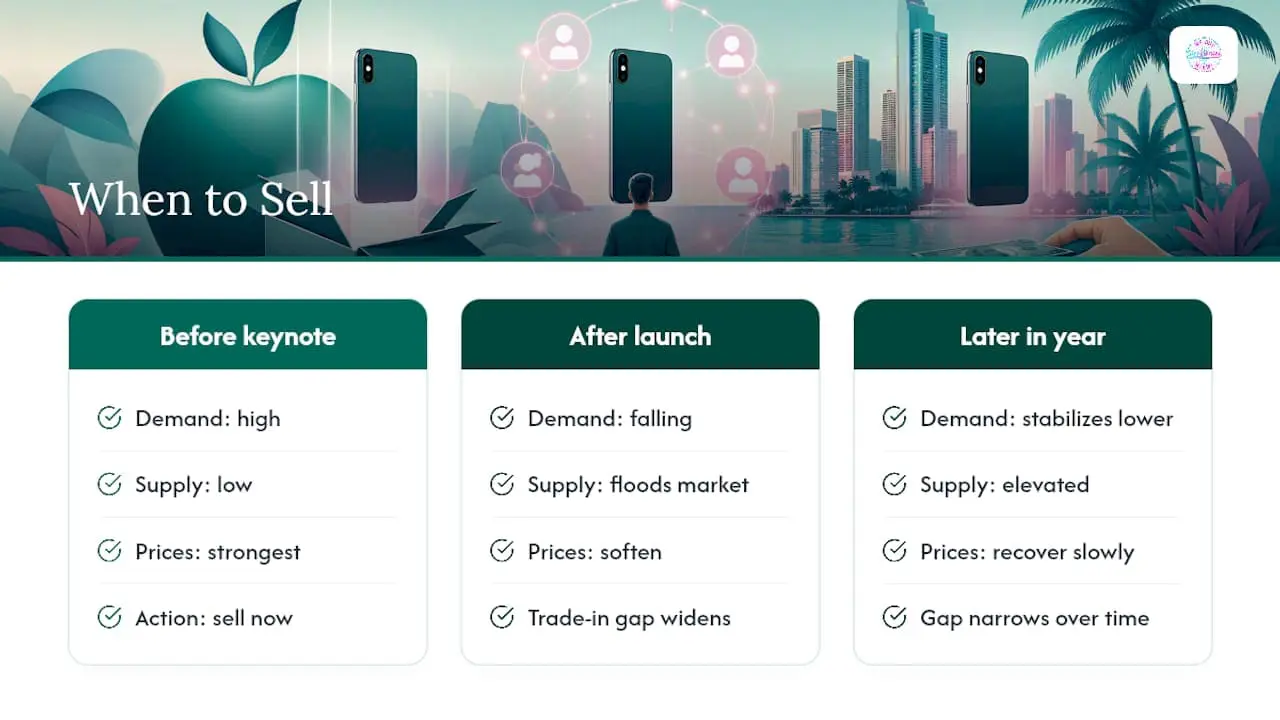
Timing changes your payout more than most sellers realize. The strongest resale window is typically the weeks just before Apple’s September keynote, when demand for older models is still high and supply hasn’t yet flooded the market. Once new devices ship, prices commonly soften as a wave of trade-ins and upgraders lists their old phones at once.
Carrier and manufacturer trade-in offers typically run $100 to $300 below open-market resale, with Pro models showing gaps of $400 or more, according to ValueSnap’s market data. That gap widens right after launch season and narrows as the year goes on.
Before you accept any number, cross-check Apple’s quote against recent sold listings for your exact model, storage size, and condition. A quote that looked reasonable in August can look thin by October.
What Safety Rules Should You Follow When Selling or Trading In?
Selling privately puts you in direct contact with strangers, so basic precautions matter. Meet in a public, well-lit place, accept only verified payment methods, and avoid sharing your home address. Bringing a friend along for a local meetup costs nothing and adds a real layer of protection.
- Meet buyers in public locations and skip payment methods that are easy to reverse or fake.
- Use tracked shipping and hold the serial number or IMEI as proof until payment clears.
- Favor platforms with built-in buyer and seller protections when shipping to a stranger.
- Photograph your device’s exact condition before sending it in for a trade-in, since Apple’s inspection can revise the quote down, and you’ll want proof of what you actually shipped.
Why a Local Cash Buyer Is the Faster Cash Option
If shipping deadlines, marketplace negotiations, and inspection uncertainty sound like more hassle than they’re worth, there’s a third path that skips all of it: get your cash the same day, in person, with no box to pack and no buyer to chase. Local buyers pay cash on the spot for smartphones, laptops, tablets, gaming consoles, cameras, smartwatches, and more, often in whatever condition the devices are in.

This route fits you best if you need money today, your device has damage that would tank a trade-in quote or scare off a private buyer, or you’d rather avoid the back-and-forth of listing and shipping altogether. Bring your device along with a valid photo ID; if you’re selling an iPhone or another phone, having proof of ownership on hand speeds up the inspection. Check what we buy to confirm your device qualifies, then stop by for an in-person quote. No shipping, no waiting on a buyer to respond, no revised offer after the fact.
Sources
- 4 Ways to Sell or Trade In Your Old iPhone
- Trade-In vs. Sell: How to Get the Most for Your Old Tech – Swappa Blog
- iPhone Trade In Value: What Every Model Is Worth (2026) | ValueSnap Blog
